
If you’ve been running a service business for more than a few years, you’ve probably noticed something: the way leads expect to be contacted has changed, but most businesses are still following up the same way they did in 2015 — manually, slowly, and inconsistently.
That gap between what customers expect (instant contact) and what most businesses deliver (a callback hours later, if at all) is exactly why AI sales agents exist. They’re not a futuristic concept anymore. They’re being used right now by businesses across dozens of industries to follow up with leads faster, qualify prospects automatically, and book appointments without a human ever picking up the phone.
But the term “AI sales agent” gets thrown around loosely. Some companies use it to describe an email bot. Others use it for a glorified chatbot. And some use it for what it actually should mean: an AI system that can have a real, voice-based conversation with a lead, understand what they need, handle their objections, and book them into your calendar — all within 60 seconds of them reaching out.
This post breaks down what AI sales agents actually are, how the technology works, what they cost, and how to figure out whether one is right for your business.
What Is an AI Sales Agent?
An AI sales agent is software that autonomously handles parts of the sales process that would normally require a human — specifically the early-stage, high-volume work like responding to new leads, qualifying them, handling initial objections, and scheduling appointments.
The key word is autonomously. Unlike a CRM that logs data or a dialer that speeds up manual calling, an AI sales agent actually does the work. It initiates contact, carries on a conversation, makes decisions about whether a lead is qualified, and takes action (like booking an appointment or sending a follow-up text).
There are three broad categories:
- Voice AI sales agents — These make and receive actual phone calls using natural-sounding AI voices. They can have real conversations, ask qualifying questions, respond to objections, and book appointments in real-time. This is the most advanced category and the closest to replacing (or enhancing) a human SDR’s phone work.
- Email/text AI sales agents — These handle outreach and follow-up through email, SMS, or messaging platforms like WhatsApp. They write personalized messages, respond to replies, and nurture leads through automated sequences. They’re good at scale but lack the immediacy and personal touch of a phone call.
- Multi-channel AI sales agents — These combine voice, email, and SMS into a coordinated sequence. A lead might get a phone call within 60 seconds, then a follow-up text if they don’t answer, then an email later that day. This is generally the most effective approach because it meets leads wherever they’re most responsive.
What all three have in common: they operate without a human in the loop for routine interactions. Your team only gets involved when the AI has already done the initial work — qualified the lead, answered their basic questions, and either booked an appointment or flagged the lead as needing human attention.
How AI Sales Agents Actually Work
The technology behind AI sales agents has evolved rapidly, especially since 2023. Here’s what’s happening under the hood:
The Core Technology Stack
Large Language Models (LLMs): These are the “brains” of the operation. Models like GPT-4, Claude, and Gemini understand context, generate natural responses, and make decisions about how to steer a conversation. When a homeowner says “I’m just getting quotes right now,” the LLM understands this is a common objection and responds accordingly — not with a scripted line, but with a contextually appropriate response.
Speech-to-Text (STT): For voice-based agents, this converts what the caller says into text that the LLM can process. Modern STT systems operate in near-real-time with accuracy rates above 95%, even with background noise, accents, and industry-specific terminology.
Text-to-Speech (TTS): This converts the LLM’s text response back into spoken audio. The latest TTS systems produce voices that are nearly indistinguishable from human speech — with natural pacing, intonation, and even the ability to express appropriate emotion (empathy for an emergency call, enthusiasm for a new project).
Natural Language Processing (NLP): This sits between the STT and LLM layers, helping the system understand intent — not just what words were said, but what the caller actually means. “My AC’s blowing warm air” gets correctly interpreted as an urgent repair request, not a general question about HVAC systems.
Integration Layer: This connects the AI to your calendar, CRM, and communication tools. When the AI books an appointment, it’s checking your real availability and creating a real calendar entry. When it qualifies a lead, it’s updating your CRM with the details. This is what turns a clever conversational AI into an actual business tool.
What Happens During a Typical AI Sales Call
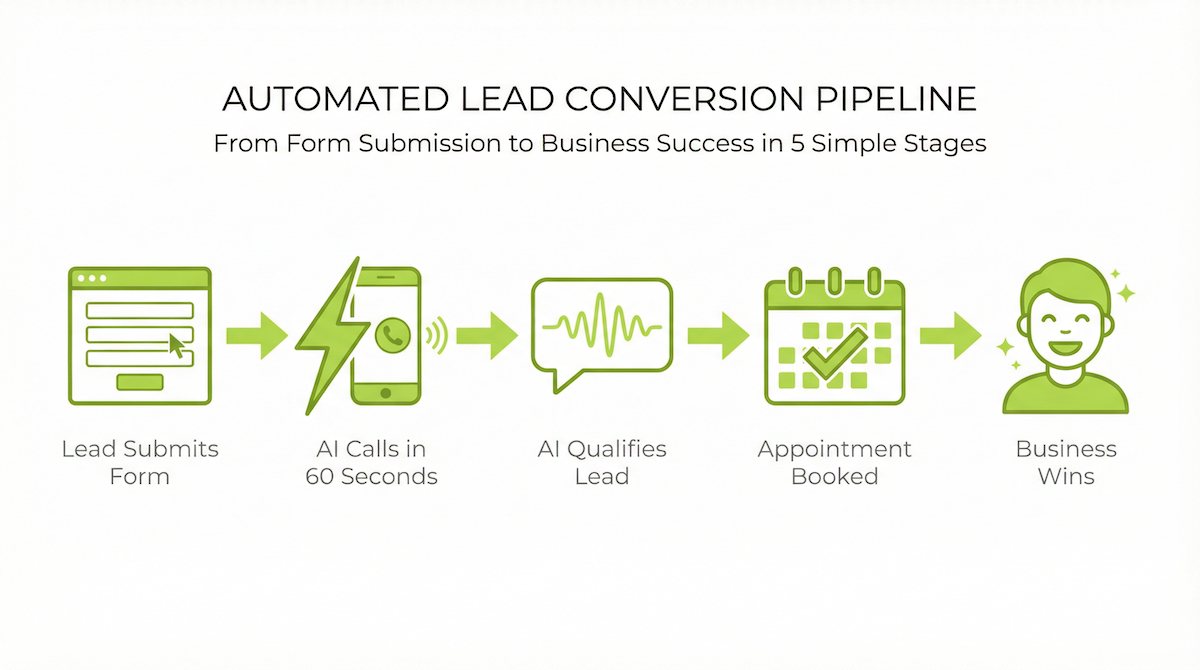
Here’s the actual sequence when a new lead comes in and an AI sales agent handles it:
- Trigger: A lead fills out a form on your website, clicks your Google Local Service Ad, or responds to a Facebook ad. The AI system detects the new lead instantly.
- Initiation: Within seconds (often under 60), the AI places an outbound call to the lead’s phone number. The lead sees a call from your business number.
- Greeting & Context: The AI introduces itself and references why it’s calling: “Hi, this is Sarah calling from [Your Company]. I see you just requested a quote for AC repair — I’d love to help get you scheduled.”
- Qualification: The AI asks targeted questions based on your specific business: What service do you need? What’s the timeline? Have you worked with us before? Is this residential or commercial?
- Objection Handling: When the lead pushes back (“I’m just comparing prices” or “Can you just text me a quote?”), the AI responds with trained rebuttals — explaining why an in-person estimate is more accurate, offering to match competitors, or building urgency around availability.
- Booking: If the lead is qualified and interested, the AI checks your calendar in real-time and offers available slots: “I have openings this Thursday at 10 AM or Friday at 2 PM — which works better for you?”
- Confirmation: The lead gets an instant SMS confirmation with the appointment details, your contact info, and any prep instructions.
- Follow-Up: If the lead doesn’t book on the first call, the AI enters a follow-up sequence — typically a series of calls, texts, and emails over the following days until the lead responds or opts out.
The entire call typically takes 2-4 minutes. From the lead’s perspective, it feels like talking to a friendly, knowledgeable receptionist — not a robot.
Want to hear an AI sales agent in action?
📞 Call +1-561-258-9668 — Talk to Our AI Now
Our AI answers the phone. Experience it yourself in under 2 minutes.
Core Functions of an AI Sales Agent
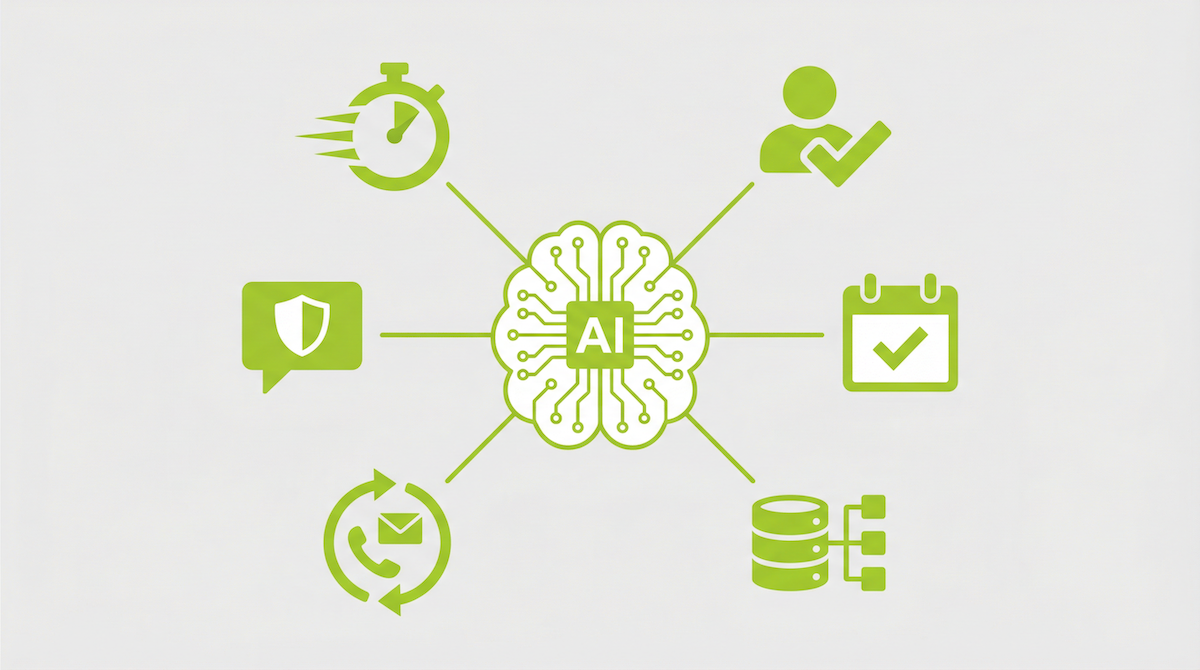
Not every AI sales agent does all of these, but here are the core capabilities that define the category:
1. Speed-to-Lead Response
This is the single most important function. Research from MIT and Harvard Business Review consistently shows that contacting a lead within 5 minutes makes you 100 times more likely to reach them compared to waiting 30 minutes. A study by Velocify found that calling within 60 seconds produces a 391% improvement in conversion rates.
Most businesses can’t do this manually. Your team is on job sites, handling existing customers, or it’s after hours. An AI sales agent responds to every lead within seconds — at 2 PM on a Tuesday or 11 PM on a Saturday.
2. Lead Qualification
Not every lead is worth your time. An AI sales agent asks the right questions to determine whether a lead is a real prospect or a tire-kicker. It can filter by service type, location, budget, timeline, and urgency — and tag the lead in your CRM accordingly. Your team only spends time on leads that are actually ready to buy.
3. Objection Handling
This is where the best AI sales agents separate themselves from basic chatbots. A chatbot gives canned responses. A well-trained AI sales agent handles objections the way a skilled salesperson would — with empathy, logic, and persistence (without being pushy). “I need to check with my spouse” gets a different response than “your price is too high” or “I already have someone coming out.”
4. Appointment Booking
The AI connects directly to your calendar or scheduling software and books appointments in real-time. No double-bookings. No “let me check and call you back.” The lead picks a time, it’s confirmed instantly, and both parties get a confirmation.
5. Multi-Touchpoint Follow-Up
The average sale requires multiple touchpoints — and your competitors are reaching out aggressively. AutoCaller’s default sequence delivers 25 touchpoints in the first week alone, with up to 17 happening on Day 1: a pre-call SMS, immediate call, a double-call within 30 seconds, and then escalating calls and texts throughout the day. The system intelligently coordinates voice calls, SMS, and email — not in separate phases, but together from minute one. And every touchpoint cadence is fully customizable to match your business and your customers’ expectations.
6. CRM & Calendar Integration
Every interaction gets logged. Call recordings, transcripts, qualification data, and booking confirmations all flow into your existing CRM — whether that’s ServiceTitan, Housecall Pro, HubSpot, Salesforce, or any other system. Your team sees exactly what happened without having to ask.
See how AutoCaller handles all 6 of these — automatically.
📞 Call +1-561-258-9668 — Talk to Our AI Now
Call our number and experience a live AI sales conversation in real-time.
AI Sales Agents vs. Other Sales Tools
The market is full of tools that claim to “automate sales.” Here’s how AI sales agents compare to what you might already be using:
| Tool | What It Does | What It Doesn’t Do |
|---|---|---|
| Answering Service | Human operators answer calls, take messages | Doesn’t qualify leads, handle objections, or book appointments in real-time. Limited hours. $1-3/minute. |
| Chatbot | Answers questions on your website via text chat | Doesn’t make phone calls. Can’t handle complex objections. Limited to scripted flows. Most visitors ignore them. |
| Auto-Dialer | Dials through a list of numbers faster than manual calling | Still requires a human to handle the conversation once someone picks up. A speed tool, not a replacement. |
| Email Sequence Tool | Sends automated email follow-ups on a schedule | Low response rates (5% average). No voice interaction. Doesn’t qualify or book in real-time. Feels impersonal. |
| CRM with Automation | Logs data, triggers reminders, sends notifications | Doesn’t contact leads or have conversations. It tells your team what to do — it doesn’t do it for them. |
| AI Sales Agent | Calls leads, qualifies them, handles objections, books appointments, follows up — autonomously | Not ideal for complex negotiations, custom proposals, or relationship-heavy enterprise sales (yet). |
The key distinction: most sales tools make your team faster. An AI sales agent does the work your team doesn’t have time to do — especially the high-volume, time-sensitive stuff like following up with new leads within 60 seconds.
Ready to stop losing leads to slow follow-up?
📞 Call +1-561-258-9668 — Talk to Our AI Now
Our AI picks up, qualifies you, and books a strategy call — just like it does for our clients’ leads.
What Industries Use AI Sales Agents?
AI sales agents are being adopted across virtually every industry where leads need fast follow-up and appointments, demos, or sales calls need to be booked. Here’s where they’re gaining traction fastest:
- Home Services: HVAC, roofing, plumbing, electrical, pest control, landscaping, solar, garage door, and more — techs are in the field and can’t answer every call. Average job values ($3,000–$20,000) mean one additional booking per week pays for the AI many times over.
- Coaches, Consultants & Course Creators: High-ticket coaching programs and consulting engagements are sold through discovery calls and Zoom sessions. AI qualifies inbound leads (“What’s your current revenue? What are you looking to achieve? What’s your budget?”) and books them directly into the calendar. Speed matters here too — a lead who fills out a coaching application at 10 PM expects a fast response, not an email three days later.
- Real Estate: Agents receive dozens of inquiry calls per listing. AI handles initial qualification (“Are you pre-approved? What’s your budget? When are you looking to move?”) and books showings or consultations.
- Insurance & Financial Services: High-volume lead follow-up for quotes and consultations. AI handles initial information gathering, qualifies by policy type or investment range, and books meetings with agents or advisors.
- Health & Wellness: Med spas, dental practices, chiropractors, cosmetic surgery offices — appointment-driven businesses with high call volume and significant after-hours inquiries. AI books consultations and follows up with leads who didn’t commit on the first interaction.
- Legal: Law firms use AI to qualify potential clients during intake calls — filtering by case type, jurisdiction, and urgency before scheduling consultations with attorneys.
- Agencies & B2B Services: Marketing agencies, IT services, staffing firms — any business that sells through strategy calls or demos. Leads fill out a form, and the AI calls them within a minute to qualify and book the meeting.
- Automotive: Dealerships use AI to follow up with service leads, schedule test drives, and re-engage past customers for trade-in offers.
The common thread: any business where the sales process starts with booking a call, appointment, or demo — and where leads go cold if you don’t follow up fast — is a fit for an AI sales agent. The specific industry almost doesn’t matter. What matters is that leads come in, speed determines who wins, and there’s a meeting to be booked.

Whatever your industry — if you book appointments, we can help.
📞 Call +1-561-258-9668 — Talk to Our AI Now
Hear AutoCaller handle a real conversation — then we’ll show you how it works for your business.
What Does an AI Sales Agent Cost?
Pricing varies significantly depending on the type of platform, whether it’s DIY or done-for-you, and what features are included. Here’s the general landscape as of early 2026:
Per-Minute Pricing (DIY Voice Platforms)
Platforms like Bland AI, Vapi, Retell AI, and Synthflow charge by the minute for AI call time. Base rates range from $0.05 to $0.15 per minute, but the actual cost is usually higher once you add in LLM processing fees, speech-to-text, text-to-speech, and telephony charges. A realistic per-minute cost is $0.15–$0.35 when everything is factored in.
These platforms are typically self-service — you build the AI agent yourself, write the scripts, set up integrations, and manage ongoing optimization. They’re best for technically savvy teams or businesses with in-house developers.
Per-Seat / Flat Monthly (Enterprise Platforms)
Platforms like Conversica, Drift (now part of Salesloft), and Outreach charge flat monthly fees or per-seat pricing, often starting at $2,500/month and scaling into six figures annually for enterprise deployments. These are built for large sales organizations with dedicated operations teams.
Done-For-You Services
Some companies — including iGreen AI Solutions — offer AI sales agents as a fully managed service. The best way to understand this model is to think of it like staffing: instead of hiring and managing a new sales or reception employee yourself, you work with a provider who handles the hiring, training, scheduling, and ongoing management of the AI on your behalf. You pay a one-time setup fee (AutoCaller: $3,000) plus a monthly management fee ($797–$1,497/month depending on volume) and a flat $0.15/minute usage fee for AI voice calls. The provider handles everything: script writing, AI training, calendar and CRM integration, follow-up workflow setup, and ongoing optimization. When your business changes — new campaigns, new ad sources, new service lines — they update the AI for you. This model is designed for business owners who want the results of a 24/7 sales and reception employee without the overhead of hiring or managing one.
For a deeper breakdown of pricing across specific platforms, see our complete AI sales agent pricing guide. For a direct comparison of voice-first AI against email-based alternatives, see voice AI vs. email bots.
How to Choose the Right AI Sales Agent
With dozens of options on the market, here’s what actually matters when choosing:
1. Voice vs. Email vs. Both
If your customers expect a phone call — which is true for home services, professional services, healthcare, real estate, and most businesses selling through consultations or Zoom calls — you need a voice-capable AI. Email-only tools are better suited for high-volume outbound prospecting where you’re reaching cold contacts at scale. For most businesses booking appointments or demos, the best approach is multi-channel: voice calls as the primary touchpoint, with SMS and email for follow-up.
2. DIY vs. Done-For-You
Be honest about your team’s technical capabilities and bandwidth. A DIY platform is a software tool — you still need to write the scripts, configure the workflows, connect the APIs, manage retries, and troubleshoot when something breaks. If you have developers or a dedicated marketing operations person, that’s manageable. If you’re a business owner running a team, it rarely is. A done-for-you service saves you weeks of setup time and eliminates the ongoing management entirely — think of it less like buying software and more like bringing on a trained staff member, with a provider who manages that employee on your behalf.
3. Industry-Specific Training
A generic AI sales agent doesn’t know the difference between a furnace repair and a full HVAC system replacement. It doesn’t know that a coaching lead asking about “accountability” has different buying intent than one asking about “pricing.” Every industry has its own objections, qualifying questions, and terminology. Look for solutions that can be trained on your specific conversations — or better yet, providers that handle that training for you.
4. Integration With Your Existing Tools
The AI needs to connect to your calendar and CRM. Whether you’re using ServiceTitan, Housecall Pro, HubSpot, Salesforce, Calendly, Google Calendar, or any other tool — make sure the AI sales agent can integrate, either natively or through connectors like Zapier.
5. Transparent Pricing
Watch out for hidden costs. Some platforms advertise a low per-minute rate but don’t mention the additional LLM fees, telephony charges, or minimum usage commitments. Ask for the total cost per call, not just the base rate.
For a detailed side-by-side comparison of the major AI sales agent platforms, see our best AI sales agents comparison guide. If you want to understand how these systems connect to your existing tools, check our CRM integration guide.
How AutoCaller Fits In
At iGreen AI Solutions, we built AutoCaller because we saw the problem firsthand. We’ve been building websites, running SEO campaigns, and generating leads for businesses since 2011. The marketing worked — but we kept watching our clients lose leads because they couldn’t follow up fast enough. Nobody was available 24/7. Leads came in on Saturday night and didn’t get a call until Monday morning. By then, they’d already booked with someone else.
The simplest way to explain what we do: we are the staffing agency and HR department for your AI employee. AutoCaller fills the role of a hybrid sales rep and receptionist — one that answers calls, follows up with every lead within 60 seconds, qualifies prospects, handles objections, books appointments directly to your calendar, takes messages, and passes off to a live human when needed. It does all of this 24/7, every day of the year, trained specifically on your business. We handle the hiring, training, scheduling, and ongoing management. You get the results.
Importantly, AutoCaller doesn’t replace your existing team — it makes them more effective. Your receptionist or sales rep no longer has to spend their day answering calls from people who were never going to book. The AI handles intake and qualification; your human team handles the relationships, the complex questions, and the closes. Everyone works at their highest level.
AutoCaller is a voice-first, multi-channel system trained on 3+ million real sales calls. It contacts every new inbound lead in under 60 seconds and follows up with a 25-touchpoint sequence over the next several days — calls, texts, and emails — until it gets a response or a booking. We handle 100% of the setup and ongoing management: script writing, AI voice configuration, CRM and calendar integration, follow-up workflows, and updates as your business evolves. New service offerings, new ad campaigns, seasonal promotions — we retrain and adjust the system for you. You don’t touch the technology.
We work with businesses across dozens of industries — from HVAC companies and roofers to coaches, consultants, med spas, law firms, real estate agents, and any business where a missed lead means a missed sale. If your sales process involves booking a call or appointment, AutoCaller is built for you.

If you want to experience it yourself, the fastest way is to just call us. Our AI answers the phone — you’ll talk to AutoCaller directly, it’ll have a real conversation with you, and it’ll book you into a Zoom strategy session with our team.
Ready to Turn More Leads Into Booked Appointments?
Call the number below. Our AI answers the phone — experience AutoCaller firsthand.
Our AI qualifies your business, learns what you need, and books a Zoom strategy session with our team. You’ll know within 2 minutes whether this is right for you.