

Pricing for AI sales agents is one of the most confusing topics in the space — and deliberately so. Platforms advertise “$0.05 per minute” without mentioning the LLM costs, telephony fees, and speech processing charges that triple the real price. Others show a $29/month headline while burying the per-usage fees in footnotes. And enterprise platforms won’t publish pricing at all, preferring to send you through a sales process before you see a number.
This guide breaks it all down: the four pricing models, the hidden costs most buyers don’t catch until their first bill, realistic price ranges for each category, and a straight comparison of what you’re actually paying when you factor everything in.
We run AutoCaller, our own done-for-you AI sales agent. We have an obvious interest in how this guide turns out — so we’re going to be extra transparent, including where our pricing isn’t the cheapest option and when a cheaper alternative might genuinely make more sense for your situation.
All pricing figures reflect what was publicly available or verifiable as of early 2026. AI software pricing changes frequently. Verify current pricing directly with each provider before making purchasing decisions.
The Four AI Sales Agent Pricing Models
Before comparing specific platforms, you need to understand the four ways these products are priced — because mixing models makes comparison impossible.
1. Per-Minute Pricing
The most common model for voice AI platforms. You pay for AI call time, typically billed by the second or in 6-second increments. The advertised rate is almost never the real rate — you’ll also pay for the language model that powers the conversation (LLM costs), the technology that converts your caller’s words to text (speech-to-text / STT), the technology that converts the AI’s responses back to speech (text-to-speech / TTS), and telephony infrastructure (the actual phone call).
A platform advertising $0.05/minute might realistically cost $0.23–$0.33/minute fully loaded. Always ask for the all-in cost per call, not the base rate.
2. Flat Monthly Subscription
A fixed monthly fee, sometimes with usage limits and overage charges. Simpler to budget for, but watch for minimum usage commitments and what happens if you go over your included minutes or leads. Some platforms also require annual contracts at the monthly rate, so the “cancel anytime” implication isn’t always accurate.
3. Per-Lead or Per-Seat Pricing
Some appointment setter tools charge per lead contacted, making costs directly variable with your lead volume. Per-seat pricing (common in enterprise platforms) charges per user accessing the system, which can escalate quickly if you have multiple team members.
4. Done-For-You Service Pricing
A hybrid model common for managed service providers: a one-time setup fee covering the build, training, and integration, followed by a recurring monthly management fee. The most useful way to understand this pricing model is to stop thinking of it as software and start thinking of it as staffing. You’re not paying for a license — you’re paying for a trained AI employee plus the HR and management infrastructure that keeps that employee performing. The setup fee is the hiring and onboarding cost. The monthly fee is the management retainer. This model includes everything the other models charge separately for — plus the ongoing labor they never include at all: script updates, new campaign builds, workflow changes, and performance optimization.
Want to know exactly what AutoCaller would cost for your business?
📞 Call +1-561-258-9668 — Talk to Our AI Now
Our AI answers, qualifies your situation, and books a Zoom pricing call with our team.
Hidden Costs to Watch For
This is the section most pricing guides skip. Before committing to any AI sales agent platform, get explicit answers to the following:
LLM Processing Fees: The large language model that powers the AI’s conversation costs money per token (roughly per word processed). On a 3-minute qualifying call, this can add $0.08–$0.15 per call on top of the base per-minute rate. Multiply that by 500 calls per month and you’re looking at $40–$75 in LLM fees alone that weren’t in the advertised price.
Speech-to-Text and Text-to-Speech: Converting spoken audio to text (and back) costs money. Premium voice quality — the kind that sounds human and natural — costs more than robotic synthesized speech. Platforms that use premium TTS providers like ElevenLabs or OpenAI’s voice models charge accordingly.
Telephony / Phone Number Costs: Local phone numbers, toll-free numbers, and per-minute carrier charges for outbound calls are often separate from the AI platform’s fees. Expect $1–$5/month per number plus carrier fees on top of AI fees.
Setup and Onboarding Fees: Many platforms charge for initial setup, even if they don’t advertise it prominently. Make sure you understand the total out-of-pocket to go live, not just the monthly recurring cost.
Minimum Commitments: Some platforms require minimum monthly spend or annual contracts. A platform that costs $297/month but requires a 12-month commitment is a $3,564 minimum investment, not a $297 trial.
Overage Charges: If your plan includes 500 minutes and you use 650, what’s the overage rate? Some platforms charge 2–3x the standard per-minute rate for overage minutes.
Pricing by Category: What You’ll Actually Pay
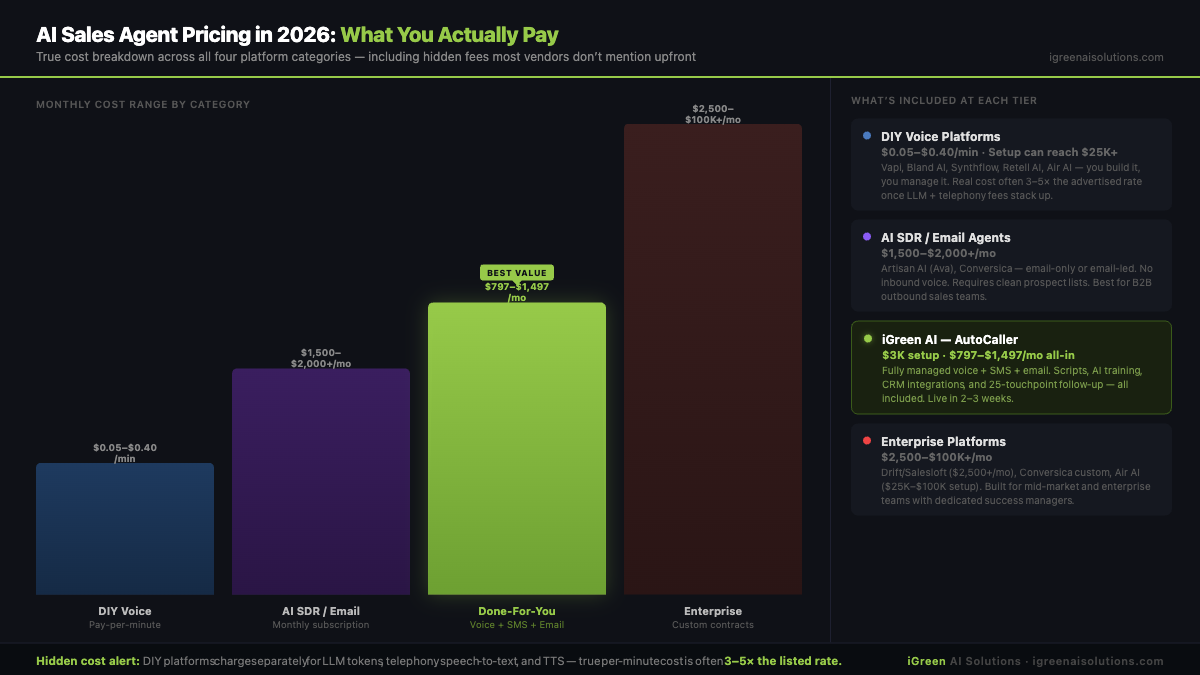
DIY Voice Platforms: $0.05–$0.15/min (real: $0.15–$0.40/min)
This category includes Bland AI, Vapi, Retell AI, and Synthflow. Headline per-minute rates look cheap, but fully loaded costs are substantially higher.
Bland AI: Base rate $0.09/minute. Monthly plans from approximately $299–$499. Requires code to use. Best for developers who want maximum control. Real per-call cost depends heavily on call length and LLM usage.
Vapi: Base rate $0.05/minute — but this is the most frequently misunderstood price in the category. Add LLM costs ($0.05–$0.10/min for GPT-4 class models), STT ($0.04–$0.07/min), TTS ($0.06–$0.10/min for premium voices), and telephony ($0.01–$0.02/min), and your real cost is typically $0.21–$0.34/minute for a well-configured agent. At 200 minutes of call time per month, that’s $42–$68 — plus the technical time to build and manage the system.
Retell AI: Base rate $0.07+/minute with similar add-ons. Strong compliance (HIPAA/SOC 2 in progress). Better fit for regulated industries. Similar real cost structure to Vapi.
Synthflow: Starts at $29/month for limited minutes, with per-minute rates around $0.08 for higher tiers. The most accessible DIY option, though you’re still building and managing the AI yourself.
Air AI: In a different cost tier entirely — $25,000–$100,000 upfront setup plus $0.11–$0.32/minute. This is enterprise infrastructure designed for companies running thousands of calls per day with dedicated technical teams.
Enterprise Platforms: $2,500–$100,000+/month
This category includes Conversica, Drift/Salesloft, and Outreach. These are not realistic options for most small or mid-size businesses — they’re priced for enterprise revenue operations teams with six-figure software budgets.
Conversica: Custom pricing. Enterprise deployments typically run well into five figures annually. Most appropriate for companies with revenue teams of 20+ people and large inbound lead volume.
Drift/Salesloft: Plans start around $2,500/month for the entry level, scaling significantly for full feature sets. Built for B2B SaaS companies with high-volume inbound website traffic.
AI SDR Services: $1,500–$2,000+/month
Artisan AI (Ava): Email-only AI SDR focused on outbound B2B prospecting. Estimated pricing $1,500–$2,000+/month. Not appropriate for service businesses or any use case requiring voice calls.
Done-For-You Services: $797–$1,497/month + Setup + $0.15/min
iGreen AI AutoCaller: $3,000 one-time setup fee (covers script writing, AI training, calendar and CRM integration, testing, and going live). Monthly management: $797/month for smaller operations, $1,497/month for larger operations or multiple locations. Plus $0.15/minute for AI voice calls — a flat, fully loaded rate with no hidden stacking of LLM, telephony, or TTS fees. Unlike every DIY platform on this list, the monthly fee isn’t just software access — it includes ongoing updates, new campaign builds, script adjustments, and full management as your business evolves. For a full-service engagement that includes a website rebuild, ad campaigns, and AutoCaller as a complete growth system, pricing scales to $12,000 build + $6,000/month.
The Real Cost Comparison: AI vs. Your Current Options
Pricing only makes sense in context. Here’s how AI sales agents compare to the alternatives most businesses are already using:
| Option | Monthly Cost | Available Hours | Follows Up Within 60 Seconds? | Handles Objections? |
|---|---|---|---|---|
| Full-time receptionist | $2,800–$4,000+ | M–F, 9–5 | ❌ No | ⚡ Inconsistently |
| Answering service | $300–$1,200+ ($1–3/min) | 24/7 | ⚡ Sometimes | ❌ No |
| Inside sales rep | $4,000–$6,000+ | M–F, business hours | ❌ No | ✅ Yes (skilled rep) |
| DIY AI (Synthflow) | $100–$500+ (+ your time) | 24/7 | ✅ Yes | ⚡ If you train it well |
| iGreen AutoCaller | $797–$1,497/mo + $3K setup + $0.15/min | 24/7 | ✅ Yes (under 60 sec) | ✅ Yes (trained) |
A few things this table makes clear: a full-time receptionist costs 2–5x as much as AutoCaller and can’t follow up within 60 seconds. An answering service is cheaper but doesn’t qualify leads or handle objections. DIY AI can be inexpensive if you have the time to build and manage it — but the time investment is significant and ongoing.
ROI: When Does an AI Sales Agent Pay for Itself?
Here’s the math for a typical home services or professional services business:
Let’s say your average booked job or client is worth $3,000. Your business generates 40 leads per month. Currently, you’re following up with maybe 60–70% of them within a reasonable time frame (the rest slip through the cracks after hours, on weekends, or when your team is overwhelmed). Of the leads you do follow up with, you’re converting 20% into booked appointments.
That’s roughly 8 jobs booked per month from 40 leads, at $3,000 each = $24,000/month in revenue from inbound leads.
Now add AutoCaller. Every lead gets followed up within 60 seconds, 24/7. Research from MIT and Harvard Business Review shows that responding within 5 minutes makes you 100x more likely to reach a lead. Even if that improvement translates to a modest 25% increase in lead contact rate and a 15% improvement in conversion — you’re looking at 2–3 additional booked jobs per month.
At $3,000 per job, that’s $6,000–$9,000 in additional monthly revenue against a $797–$1,497 monthly investment. The ROI is positive from month one in most cases.
The math is even more compelling for businesses with higher average job values — a roofing company with $12,000 average jobs, a coach with $5,000 programs, or a law firm with $8,000 average retainers. One additional client per month from faster follow-up is transformative at those price points.
There’s a second way to frame the ROI that many business owners find even more intuitive: compare AutoCaller to the cost of hiring. A full-time receptionist or entry-level sales rep costs $3,000–$5,000/month in salary alone — before payroll taxes, benefits, training, management time, and turnover. They work 40 hours a week, take sick days, need supervision, and quit. AutoCaller costs $797–$1,497/month plus $0.15/min in usage, works 24/7 without oversight, and never needs replacing. Your existing staff doesn’t lose their jobs — they gain bandwidth. The AI handles intake and qualification; your team handles the conversations that actually require a human. That’s a productivity gain with no additional headcount.
For a deeper look at the conversion data behind these numbers, see our guide on how AI sales agents improve lead conversion rates. Also check out our comparison of the best AI sales agents and visit the homepage for more information.
AutoCaller Pricing: A Transparent Breakdown
We believe in transparent pricing because you deserve to know what you’re signing up for before getting on a call. Here’s exactly how AutoCaller is priced:
One-Time Setup Fee: $3,000
This covers everything required to build and launch your AutoCaller system: discovery call to understand your business and your ideal customer, custom script writing tailored to your specific services and sales process, AI voice selection and configuration, calendar and CRM integration (whatever systems you already use), testing with sample leads, and a final review before going live. Most clients are live within 2–3 weeks of kickoff.
Monthly Management: $797 or $1,497/month
The $797/month plan covers smaller operations generating up to roughly 200 inbound leads per month. The $1,497/month plan covers larger operations with higher lead volume, multiple locations, or more complex follow-up sequences. Both plans include ongoing optimization as call data comes in, script updates as needed, and direct support access through your dedicated Slack channel. This isn’t a software subscription — it’s a fully managed service. As your business evolves, we evolve the system with you: new campaigns for seasonal promotions or events, retraining the AI for new paid ad audiences, adding receptionist functionality for inbound calls, adjusting scripts for new service offerings. Whatever changes, we handle the updates.
Usage Fee: $0.15/minute for AI voice calls
Every minute of AI voice call time is billed at a flat $0.15/minute. This rate is fully loaded — no LLM surcharges, no telephony markups, no hidden tiers stacked on top. SMS messages and email sends are also billed at cost. For a typical service business running 300–600 leads per month with average call lengths of 2–4 minutes, usage fees run approximately $90–$360/month. Compare that to DIY platforms where the real per-minute cost reaches $0.25–$0.40 once LLM, telephony, and TTS fees are added — and where you’re also paying for your own setup time, configuration, and ongoing management.
Full-Service Packages:
For businesses that also need a website rebuild, video ad production, Meta ad campaigns, and AutoCaller as a complete growth system, we offer full-service engagements. These are scoped individually and typically run $10,000–$15,000 for the build plus $4,000–$8,000/month for ongoing management. Contact us for details.
For a side-by-side comparison of AutoCaller versus the DIY platforms, see our complete AI sales agent comparison guide. And if you’re evaluating how AutoCaller connects to your existing CRM or calendar, the CRM integration guide covers everything from ServiceTitan to HubSpot to Zapier.
Get a Price Quote for Your Specific Business
Call the number below. Our AI answers the phone, learns about your business and lead volume, and books a Zoom strategy call where we give you an exact quote — no pressure, no obligation.
You’ll talk to AutoCaller directly — experience it firsthand, then decide if it’s right for you.