

A lead comes in at 2:47 PM on a Wednesday. Your sales team is in a call. Your CRM dings. And for the next 15 minutes, that lead sits uncontacted.
By the time someone responds, the prospect has moved on. They’ve called three competitors. They’ve made their first impression of your company: slow.
This isn’t a failure of your team. This is a failure of speed. And it’s costing you money every single day.
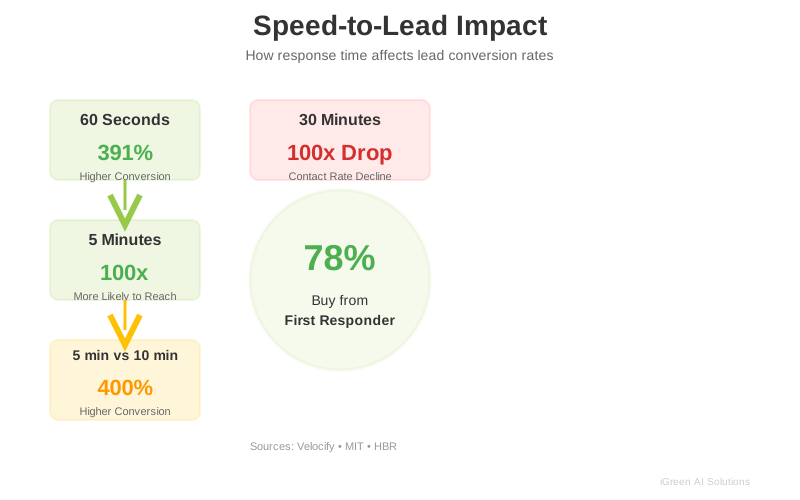
The data on this is brutal. MIT research shows that contacting a lead within 5 minutes makes you 100 times more likely to establish meaningful contact than waiting 30 minutes. Harvard Business Review found that responses at 5 minutes convert at 400% higher rates than responses at 10 minutes. Velocify’s data on 3.5 million leads showed that following up within 60 seconds produces a 391% higher connect rate than waiting even 10 minutes.
This post is about the math. Why speed matters. How AI sales agents close this gap. And what the ROI actually looks like when your company responds in 60 seconds instead of 30 minutes.
The Speed-to-Lead Problem: Why Most Leads Never Convert
Let’s start with a brutal fact: most leads don’t fail because your product isn’t good. They fail because no one picked up the phone.
Think about your own buying behavior. When you call a business, how long do you wait? If someone doesn’t answer in the first minute or two, you hang up and call the next company on the list. You don’t sit on hold for 15 minutes hoping someone eventually gets back to you.
Yet that’s exactly what happens to your leads every day.
The reasons are obvious:
- Your sales reps are already on calls or emails
- Inbound calls come in unpredictably
- You don’t have the staff to answer every phone simultaneously
- Someone has to qualify the lead before passing it along
- By the time a human gets there, the moment has passed
This isn’t a sales problem. It’s a capacity problem. And capacity costs money.
If you hire another full-time sales rep to answer calls faster, you’re paying $35,000–$60,000 per year in salary alone, plus benefits, plus manager time, plus training. You need them available 8+ hours per day. And you need one for every 20–30 concurrent calls you want to handle.
That’s the old way. And it’s broken.
What the Research Actually Says: The Math of Response Speed
Before we talk about solutions, let’s lock in the data. Because the speed-to-lead effect isn’t marketing hype—it’s documented across multiple industries and datasets.
MIT: 100x Better Contact Rates at 5 Minutes
The MIT Lead Response Management Study (Dr. James Oldroyd, InsideSales.com) analyzed over 100,000 call attempts and found that the probability of reaching a lead drops dramatically based on response time:
- Respond within 5 minutes: baseline (100%)
- Respond within 10 minutes: 39% less likely to reach
- Respond within 30 minutes: 99% less likely to reach
Translation: if you reach a lead in 5 minutes, you’re 100 times more likely to actually speak with them than if you wait 30 minutes. That’s not incremental. That’s exponential.
Harvard Business Review: 400% Higher Conversion at 5 Minutes vs. 10 Minutes
HBR’s research on sales velocity tracked conversion rates (not just contact rates—actual deals closed) based on follow-up speed:
- Follow-up within 5 minutes of inquiry: 400% higher conversion rate
- Follow-up within 10 minutes: baseline for comparison
- Follow-up within 30 minutes: 40% of 10-minute conversion rate
The gap between 5 minutes and 10 minutes is massive. That’s a 400% difference in closed deals from responding 5 minutes faster.
Velocify: 391% Connect Rate at 60 Seconds
Velocify analyzed 3.5 million leads across 400+ companies and published their findings on optimal follow-up timing:
- First contact attempt within 60 seconds: 391% higher connect rate than waiting 10 minutes
- Second attempt within 60 seconds: 90% higher connect rate
- Third attempt within 60 seconds: 60% higher connect rate
The data shows that speed isn’t just about the first call. It’s about rapid, sequential follow-up. Two to three attempts in rapid succession beat a single call hours later.
Invoca: 37% First-Call Conversion from Actual Call Data
Invoca analyzed more than 60 million phone calls and found that when companies respond immediately and follow certain conversation patterns, first-call conversion (a close or qualified appointment set on the first interaction) reaches 37%. Their 2025 Call Conversion Benchmarks Report confirms these numbers across nine industries. This isn’t common—most industries see 5–15% first-call conversion—but it proves that speed combined with proper qualification unlocks dramatically better results.
Industry Standard: 78% Buy from First Responder
Across multiple industry studies, 78% of prospects buy from whichever company responds to them first. Not the cheapest. Not the most persuasive. The fastest.
The Core Math: A 60-second response time vs. a 30-minute response time isn’t just faster. It’s the difference between winning 78% of your leads and losing them to competitors before you ever get the chance to call them back.
Why Most Businesses Can’t Follow Up Fast Enough
If the data is this clear, why isn’t every business responding in 60 seconds?
Because speed requires capacity, and capacity is expensive when it’s human.
Here’s the operational reality:
- Peak vs. Valley Problem: Calls don’t come in evenly. You might get 8 leads at 2 PM and zero leads until 4:30 PM. Hiring staff for peak capacity means overstaffing during valleys.
- Training Time: A new sales rep takes 4–8 weeks to reach full productivity. During that time, they’re costing money and slowing down the team.
- Turnover Churn: Sales rep turnover in most industries is 30–50% annually. That means you’re constantly hiring, training, and backfilling.
- Quality Consistency: Not every rep qualifies leads the same way. Some give away low-value deals to schedule setters. Others disqualify legitimate prospects too early.
- Scaling Economics: To double your capacity, you can’t hire one more rep. You need two or three, plus supervision, plus workspace, plus equipment. The cost scales linearly. Revenue doesn’t.
The math is simple: a human sales rep handling inbound calls full-time will answer maybe 50–80 calls per day at an average cost of $45,000–$55,000 per year. That’s $560–$1,100 per call answered, not counting the fact that they’re not closing deals while answering phones.
You literally cannot hire your way to 60-second response times. The cost would bankrupt you before you closed your first deal.
So what’s the answer?
How AI Sales Agents Solve the Speed Problem
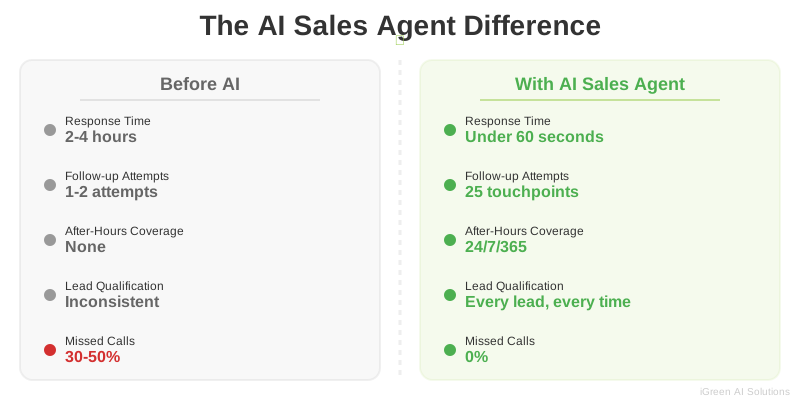
An AI sales agent answers every call in 60 seconds or less. Not sometimes. Not during business hours. Every single call.
Here’s how it works:
Immediate Answer
When a lead calls in, the AI answers on the first ring. No voicemail tag, no “all circuits are busy,” no waiting music. The lead hears a human-sounding voice trained on 3 million real sales calls. The AI is ready to listen.
Real-Time Qualification
The AI doesn’t just chat. It asks targeted qualification questions based on your specific business needs. For an HVAC contractor, it asks about the system, symptoms, and urgency. For a legal practice, it asks about case type, timeline, and budget. For a med spa, it asks about services, past procedures, and availability.
The conversation flows naturally. The prospect doesn’t feel interrogated. But by the end, you have the information you need to decide if this is a real opportunity.
Instant Handoff or Scheduling
Based on the qualification, the AI either:
- Schedules an appointment with your sales team or service department immediately (if qualified)
- Transfers the call to your highest-priority sales rep (if it needs a human touch)
- Logs the lead for follow-up (if it’s not ready yet)
No queue. No delay. By the time the call ends, the lead is either booked or handed to a human.
24/7 Availability
Calls at 11 PM on a Sunday? The AI is there. Calls at 6 AM before anyone in your office is awake? The AI answers. You capture every lead at the moment they’re most interested.
Consistent Quality
Every call is qualified the same way. Every prospect gets the same professional experience. No variation based on the rep’s mood, energy, or experience level. The AI is always at 100%.
Scalability Without Cost
Want to handle 100 calls instead of 20? No hiring. No training. No new payroll. The same system answers all 100 calls simultaneously. Same cost structure. Vastly more capacity.
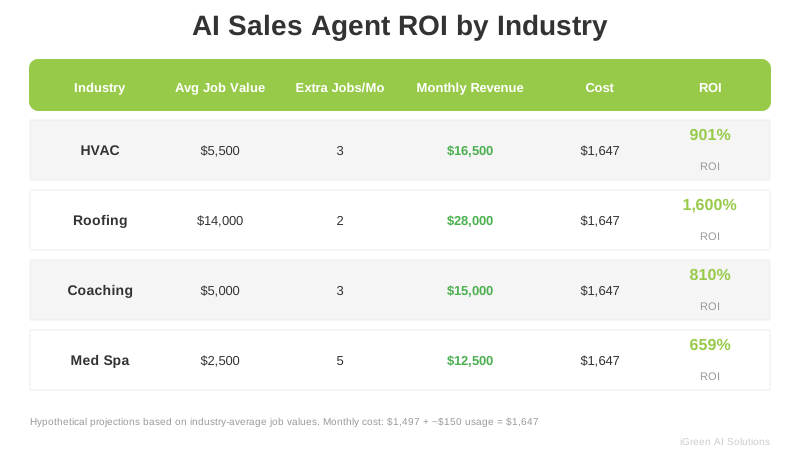
This is why the ROI math works so dramatically.
Frequently Asked Questions
▸ How fast does AutoCaller respond to new leads?
▸ What if my lead doesn’t answer the first call?
▸ Can I control how aggressive the follow-up sequence is?
▸ Does faster response time actually increase conversions?
See how AI sales agents handle your industry’s leads better than humans.